

London Exchange Meeting: Liposome Protocol Survey
Abstract
Participants in the Developer Cell Project gathered at the London Exchange Meeting and compared liposome encapsulation protocols across labs, revealing significant variation. Discussions during this meeting will help establish the engineering practice for protocol development within Nucleus and build out a framework of co-existing, category-specific protocols for benchmarking synthetic cell systems.
This Developer Note (DevNote) is a work in progress. Please leave comments on the Nucleus Forum thread here. Dialogue there will be used to update and upgrade this DevNote.
Overview
Participants in the Developer Cell Project gathered at Imperial College, London for the London Exchange Meeting. This DevNote captures key points that emerged during a discussion on the usage of the Base Cell Protocol. The Base Cell protocol is an evolution of an earlier effort to create alignment around a liposome preparation protocol that emerged from the Build a Cell community in 2018.
A key goal of the Developer cell program is to build an engineering practice that enables the integration of an increasing number of engineered components into synthetic cells. This requires not only the use of community accepted protocols with clearly defined interfaces but also a community practice for modifying and extending standard protocols that evolve as the field matures to address new and greater challenges. The London exchange meeting is an important step in establishing this practice.
It is clear that advancing the field will require not a singular ideal protocol but rather category-specific protocols that enable benchmarking, along with a framework for their continued improvement.
State of Affairs
As it stands, there is significant variation in the protocols used by the members of the collaboration.
| Lab | Method |
|---|---|
| Lab 1 | Film |
| Lab 2 | Lipid film |
| Lab 3 | Lipid film |
| Lab 4 | Lipid film |
| Lab 5 | Thin film |
| Lab 6 | Thin film |
| Base Cell Protocol | Oil-CHCl₃ mix |
| Lab | Composition | Concentration |
|---|---|---|
| Lab 1 | POPC | 3 mg/mL |
| Lab 2 | 90/10 POPC/Cholesterol | ~0.4 mg/mL (0.5 mM) |
| Lab 3 | DOPC or POPC | 4 mg/mL |
| Lab 4 | 97/3 POPC/Biotin | 2 mg/mL |
| Lab 5 | POPC ± Chol (2:1 or 9:1), also DOPC | 15 mg/mL (20 mM) |
| Lab 6 | 60/30/10 POPC/Chol/(POPE or POPA or POPG) | 15 mg/mL (20 mM) |
| Base Cell Protocol | 70/30 POPC/Cholesterol | 3 mg/mL |
| Lab | Oil phase | Outer solution | Osmolarity |
|---|---|---|---|
| Lab 1 | Thermo Scientific (415080010) | 1.1 M glucose + 50 mM HEPES | ~1150 mOsm |
| Lab 2 | Mineral oil, light (Sigma M5904) | PBS (~300 mOsm) or Tris-HEPES (~1180 mOsm) | ~300–1180 mOsm |
| Lab 3 | Mineral oil | 0.5 M glucose in PBS | ~500+ mOsm |
| Lab 4 | Mineral oil (Sigma) | 1086 mM glucose, 50 mM HEPES | ~1136 mOsm |
| Lab 5 | Bioultra mineral oil (Sigma 69794) | 400 mM glucose in 1 M HEPES | ~1400 mOsm |
| Lab 6 | Bioultra mineral oil | sMix + 100 mM glucose + 100 mM HEPES | variable |
| Base Cell Protocol | Thermo Scientific (415080010) | 850 mOsm (glucose) | ~850 mOsm |
| Lab | Inner solution | Oil volume | Column layering |
|---|---|---|---|
| Lab 1 | 10 µL | 250 µL | 260 µL emulsions, 120 µL lipid oil, 300 µL outer |
| Lab 2 | 10 µL | 600 µL | 600 µL emulsions, 300 µL lipid oil, 400 µL outer |
| Lab 3 | 10 µL | 100 µL | 100 µL oil on 150 µL glucose |
| Lab 4 | 20 µL | 200 µL | 120 µL lipid/oil on 300 µL outer, drop emulsion on top |
| Lab 5 | 20 µL | 200 µL | Entire L/O layered on 100 µL outer |
| Lab 6 | 40 µL (washboard) | 200 µL | Entire inner layered over 240 µL outer |
| Base Cell Protocol | 30 µL | 150 µL | Complete transfer; 300 µL outer |
| Lab | Density medium | Monolayer incubation |
|---|---|---|
| Lab 1 | 5% Optiprep | 1 hour |
| Lab 2 | 4–5% OptiPrep (CFE) | 15 min |
| Lab 3 | 5% Optiprep or 0.2 M maltotriose | 5–10 min |
| Lab 4 | 5% Optiprep (cytosol) or sucrose | >30 min |
| Lab 5 | 400 mM Sucrose | 5–10 min |
| Lab 6 | 100 mM Sucrose | 5 min on ice |
| Base Cell Protocol | Optiprep | 5–10 min |
| Lab | Centrifugation | Temperature |
|---|---|---|
| Lab 1 | 30 min, 9000 ×g | RT |
| Lab 2 | 10 min, 3000 ×g | RT (emulsion); 15°C (CFE centrifuge) |
| Lab 3 | 30 min, 9000 ×g | RT |
| Lab 4 | 10 min, 9000 ×g (no PURE); 30 min (with PURE) | — |
| Lab 5 | 15 min, 18,000 ×g | 4°C |
| Lab 6 | 15 min, 18,000 ×g | 4°C |
| Base Cell Protocol | 10 min, 9000 ×g | RT |
An “idealized” protocol was discussed that incorporated common features from the protocols in use following some discussion.
Table 2:Idealized protocol.
| Parameter | Idealized Protocol |
|---|---|
| Lipid preparation | Thin film |
| Lipid composition / concentration | POPC:Chol 70:30, 3 mg/mL |
| Oil phase | Bioultra (CAS 8042-47-5) |
| Outer solution | Glucose 0.5 M in DPBS 1X |
| Density medium | 5% Optiprep |
| W/O emulsions | TBD |
| Column conditions | TBD |
| Monolayer incubation | TBD |
| Centrifugation | TBD |
| Temperature | TBD |
Immediate next steps
We did not have enough time during the exchange meeting to finish defining an ‘ideal’ protocol. Instead it was agreed to capture the state of affairs and convert the ideas discussed into the present DevNote and continue the work asynchronously. As such the DevNote remains a work in progress. We expect and encourage comments on this DevNote on the associated Nucleus Forum thread.
Distributed testing
We recognize that the current protocol may not be perfect but improvements must be rooted in data. DevNotes and the Nucleus Forum provide venues for sharing data that can inform improvements to the protocol - this is data that would normally fall outside of the scope of existing modes of scholarly communication and exists significantly as remembrances.
An example of this kind of work can be found in a recent DevNote by Mary Kelly.
What data would be most useful to share? What benchmarks should be used to compare liposomes across labs, yield or module functionality?
Assistance from an Integration Node
As the integration node in the DevCells project and maintainers of Nucleus, b.next can play an important role in synthesizing insights from the project and broader community running controlled experiments across protocol variations using a single lab’s hands. As a starting point, this may involve evaluating some of the suggestions embodied in the idealized protocol.
What other roles can b.next play as an integration node to support protocol convergence across the project?
Long term vision
One thing that is clear from discussion is that the solution is not a single protocol but rather a framework for deciding between protocols that are adapted to specific use cases.
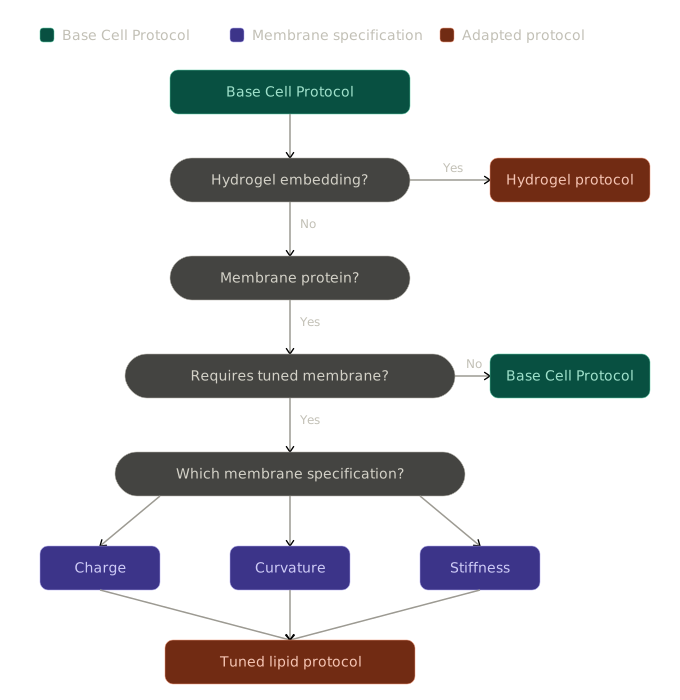
The base cell protocol is an important first step to enable benchmarking across labs. However, it may need to be adapted to produce liposomes that can be incorporated in a specific hydrogel. Since the Chicago and London Node demonstration projects both involve embedding synthetic cells into hydrogels, there is an opportunity to define the relevant benchmarking protocol.
Similarly, it may be the case that tweaking lipid composition is needed for incorporating different membrane proteins. In this case, it may be useful to define a panel of membrane specifications that are used representing specific physico-chemical properties such as charge, stiffness, or thickness that go beyond the existing Base Membrane Specification based on POPC and cholesterol used in the Base Cell Protocol.
Participants of the London Exchange Meeting: Michael Booth (University College, London), Samuel Chen (University of Michigan), Oscar Cees (Imperial College, London), Claudia Contini (Imperial College, London), Yuval Elani (Imperial College, London), Sung-Won Hwang (University of Michigan), Anton Jackson-Smith (b.next), Mary Kelly (Northwestern University), Matthew Lucia (Northwestern University), Akshay Maheshwari (b.next), Jonah McDonald (King’s College, London), Niall McIntyre (Imperial College, London), Anton Molina (b.next), Richard Murray (Schmidt Sciences), Charlie Newell (University College, London), Ojaswita Pant (Northwestern University), Julia Purrinos De Oliveira (Imperial College, London), Surendra Yadav (b.next)