

Overview
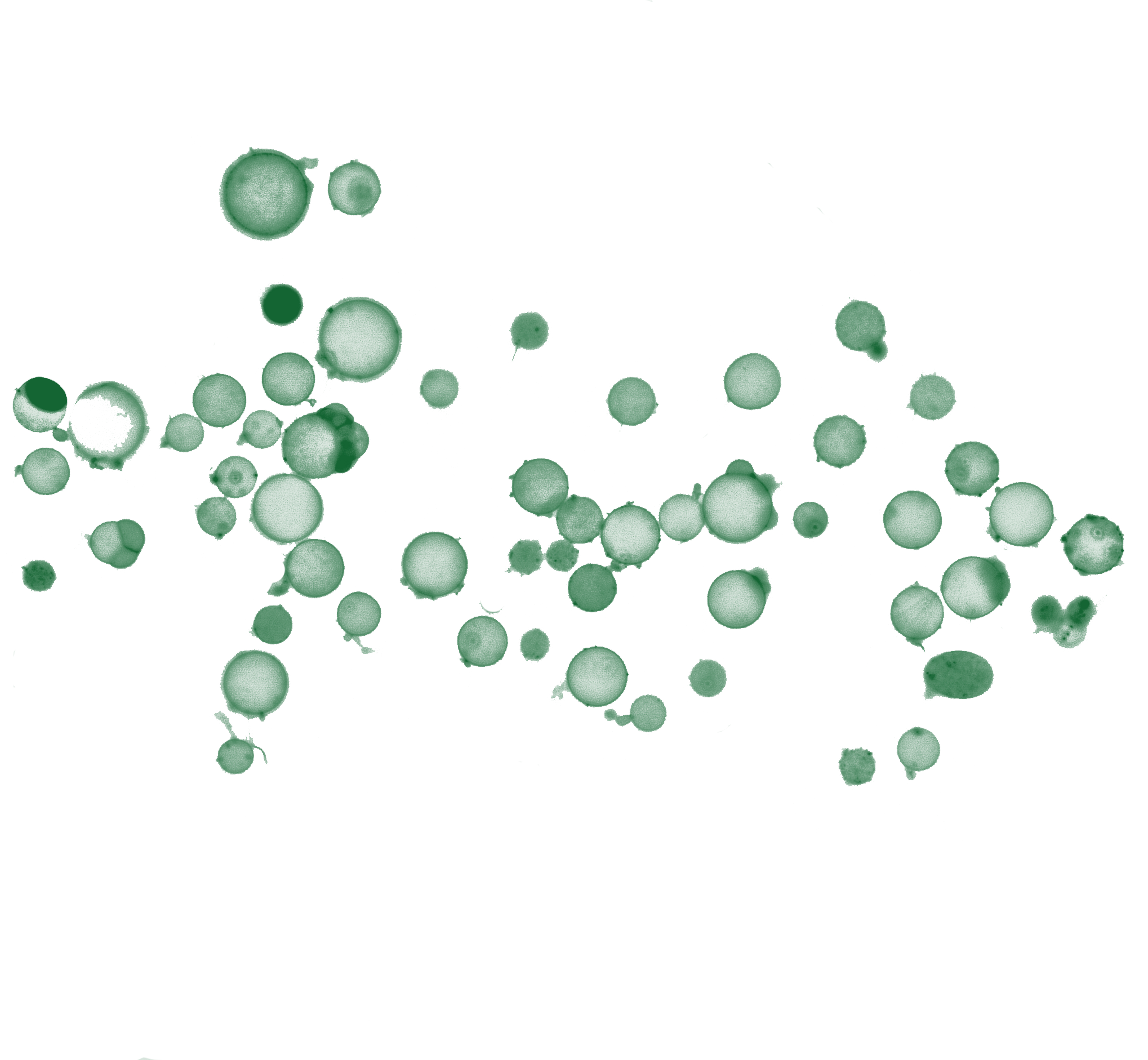
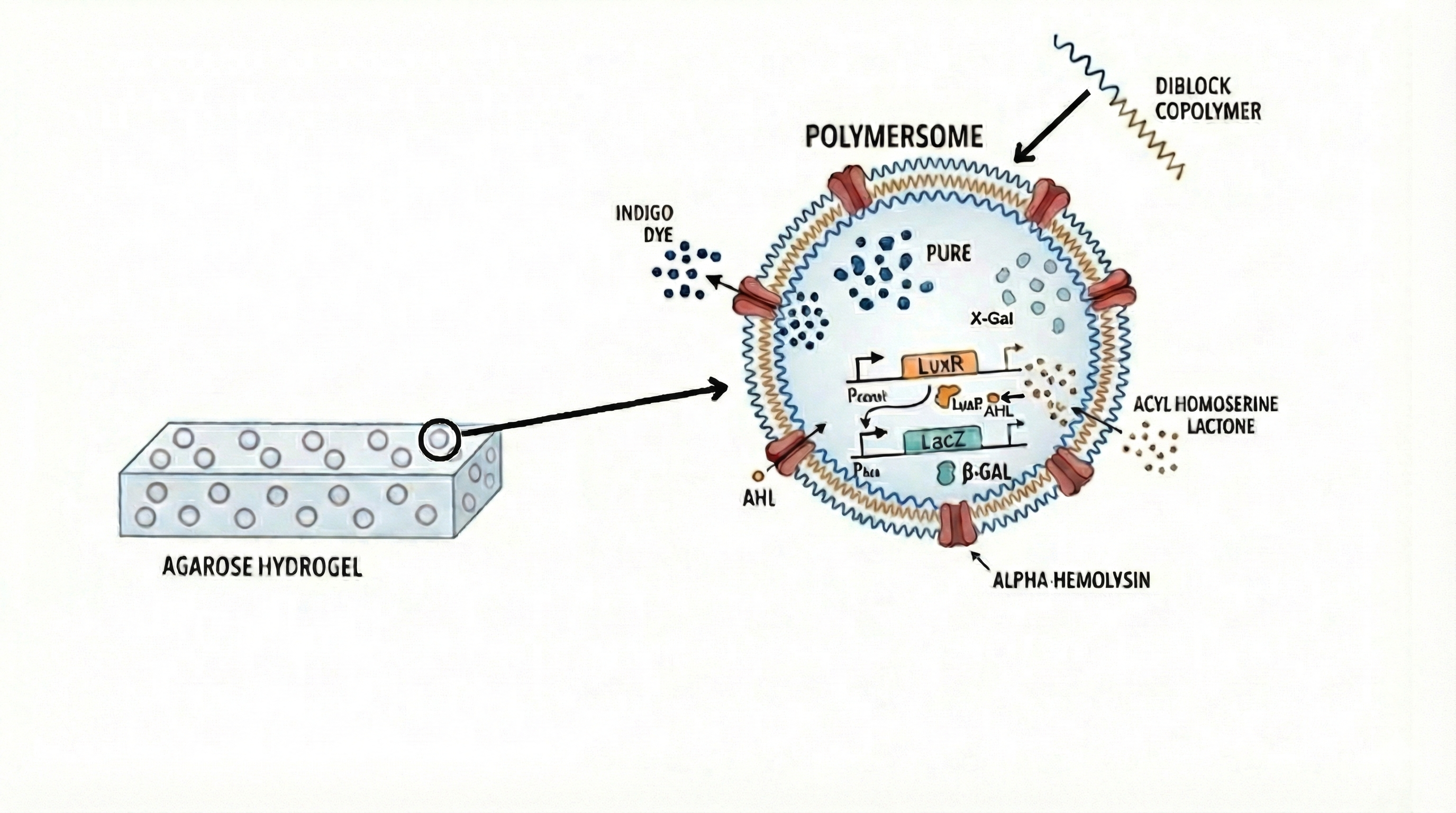
Quorum sensing polymersomes’ membranes will be made out of diblock copolymers which self-assemble to form a bilayer, similarly to lipids. These polymersomes will be a chassis for genetic circuits responsive to quorum sensing molecules (acyl-homoserine lactone) produced by biofilms and will contain PURE to express these circuits. The polymersomes will also contain X-gal which will be cleaved by beta-galactosidase when AHL is present to produce a visible indigo dye. The polymersomes will be integrated into hydrogel via 3D printing.
How The Module Works
Polymersomes will be made by phase transfer and will encapsulate PURE and LuxR inducible circuits that express beta-galactosidase. LuxR will activate expression of beta-galactosidase when AHL is present. The polymersomes will also contain X-gal which will be cleaved by beta-galactosidase when expression is activated. These polymersomes will be intergrated into an agarose hydrogel patch that can be placed on a AHL producing biofilm.
Milestones
Create polymersomes encapsulating PURE and compare to lipid GUVs
Risk: Osmolarity imbalance from PURE causing membrane instability
Success Criteria: GFP expressing in stable polymersomes
Integrate polymersomes into hydrogel that is stable for 3-4 hours. Outperforming DOPC standard GUVs in terms of time remaining stable.
Risk: Polymersomes unstable in hydrogel
Mitigation: Test different concentrations of hydrogel to assess optimal concentration for polymersome stability
Insert alpha-hemolysin into polymersome membranes
Risk: Alpha-hemolysin not inserting
Mitigation: Test insertion in different polymer compositions
Success Criteria: Successful calcein leakage assay
Expressing beta-galactosidase from quorum sensing circuits
Risk: AHL not diffusing sufficiently through hydrogel into polymersome
Mitigation: Permeability tests in different polymer compositions
Success Criteria: Produce X-gal/CPRG color change in polymersomes integrated in hydrogel
Table 1:Components
| Component | Description |
|---|---|
| Diblock copolymer | Energy mix made without folinic acid. |
| PURE | B.next cytosol |
| Ultra low gelling agarose | Gels at 8-17C |
| X-gal | Cleaved by beta-galactosidase into indigo dye |
| LuxR genetic circuits | Provided by Elani lab |
Experiments
Create polymer GUVs using phase transfer and load into agarose hydrogel
Polymer screening for best stability in hydrogel
Load GUVs with PURE and test polymer stability during expression of GFP control.
Assess permeability of quorum sensing molecules in polymer GUVs
Test beta-galactosidase reaction within polymersomes
Alpha-hemolysin insertion into polymer membranes to export cleaved X-gal.
Add quorum sensing circuits to GUVs and test with bacterial biofilms.
References
Contini, C., Hu, W. & Elani, Y. (2022) Manufacturing polymeric porous capsules. Chemical Communications. 58 (28), 4409–4419. doi:10.1039/D1CC06565C.
Ioannou, I.A., Monck, C., Ceroni, F., Brooks, N.J., Kuimova, M.K. & Elani, Y. (2024) Nucleated synthetic cells with genetically driven intercompartment communication. Proceedings of the National Academy of Sciences. 121 (36), e2404790121. doi:10.1073/pnas.2404790121.
Jacobs, M.L., Boyd, M.A. & Kamat, N.P. (2019) Diblock copolymers enhance folding of a mechanosensitive membrane protein during cell-free expression. Proceedings of the National Academy of Sciences. 116 (10), 4031–4036. doi:10.1073/pnas.1814775116.